Platform

Resources

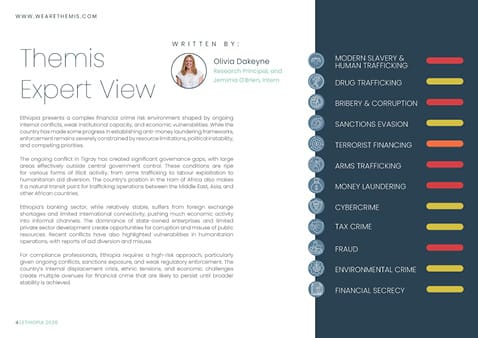
Ethiopia presents a complex financial crime risk environment shaped by ongoing internal conflicts, weak institutional capacity, and economic vulnerabilities. While the country has made some progress in establishing anti-money laundering frameworks, enforcement remains severely constrained by resource limitations, political instability, and competing priorities.
The ongoing conflict in Tigray has created significant governance gaps, with large areas effectively outside central government control. These conditions are ripe for various forms of illicit activity, from arms trafficking to labour exploitation to humanitarian aid diversion. The country’s position in the Horn of Africa also makes it a natural transit point for trafficking operations between the Middle East, Asia, and other African countries.
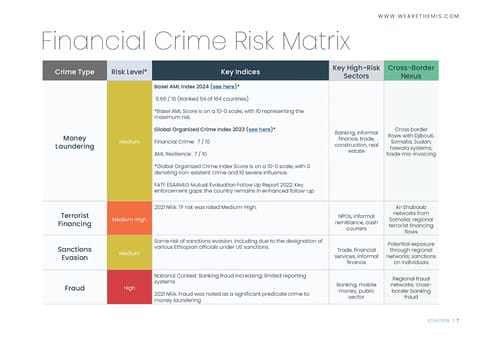
Primary methods of abuse
High-risk sectors
Relevant regulatory responses
Financial crime & compliance teams
Investment committees and operations teams assessing investment into new markets and/or potential expansion into new markets
Financial institutions onboarding clients across jurisdictions
Consultants and advisory professionals
Enhanced due diligence teams

Comprehensive jurisdictional threat overview
In-depth assessment of financial crime typologies such as money laundering, fraud, terrorist financing, tax crime and more.
Detailed sectoral risk analysis
Sector-by-sector evaluation of risk exposure, with the option to zoom in on specific industries (e.g. crypto, real estate, the precious metals sector, legal and other professional business services).
Typology deep dives and red flags
Detailed analysis of real-world typologies, high-risk behaviours and jurisdiction-specific red flags.
Customised watchpoints and recommendations
Forward-looking insights and actionable advice tailored to your business model, client profile, or regional footprint.