Summary Briefing
The Teapot Network: IRGC Networks, Shadow Finance, and the Escalation of Sanctions Evasion Tactics
Iran's Supreme Leader has called for economic warfare. The US has responded with Operation Economic Fury - the most aggressive enforcement campaign in a generation. At its centre is a network hiding in plain sight: small independent Chinese refineries, known as teapot refineries, processing hundreds of millions of barrels of sanctioned Iranian crude, connected by shadow banking, front companies, and a financial system deliberately built to bypass the US dollar entirely. This briefing maps the architecture of evasion - and what it means for your exposure.
What's Inside
- A full account of Operation Economic Fury - the US Treasury-led enforcement campaign launched alongside military action in Iran, targeting entire ecosystems of illicit finance rather than individual counterparties, with over 1,000 Iran-related designations since February 2025 and close to half a billion dollars in frozen cryptocurrency assets
- A detailed examination of China's teapot refinery network - the small independent operators in Shandong province collectively processing 1.38 million barrels of Iranian crude per day, how they differ from cautious state-owned refiners, and why OFAC has placed them at the centre of its enforcement focus including a target warning issued in April 2026
- A deep dive into the shift away from dollar-denominated settlement - how Iran and China are increasingly using CIPS, China's yuan-based alternative to SWIFT, to process Iranian oil payments entirely outside the US correspondent banking system, degrading the very chokepoint that secondary sanctions depend upon
- An analysis of the Rahbar shadow banking architecture - the networks of overseas shell companies overseen by designated Iranian banks including Bank Sepah and Bank Melli, used to route oil receipts back to the regime through layers of obfuscation, including UK-based Shuqun Ltd which transferred over $70 million in Iranian crude payments through 2024
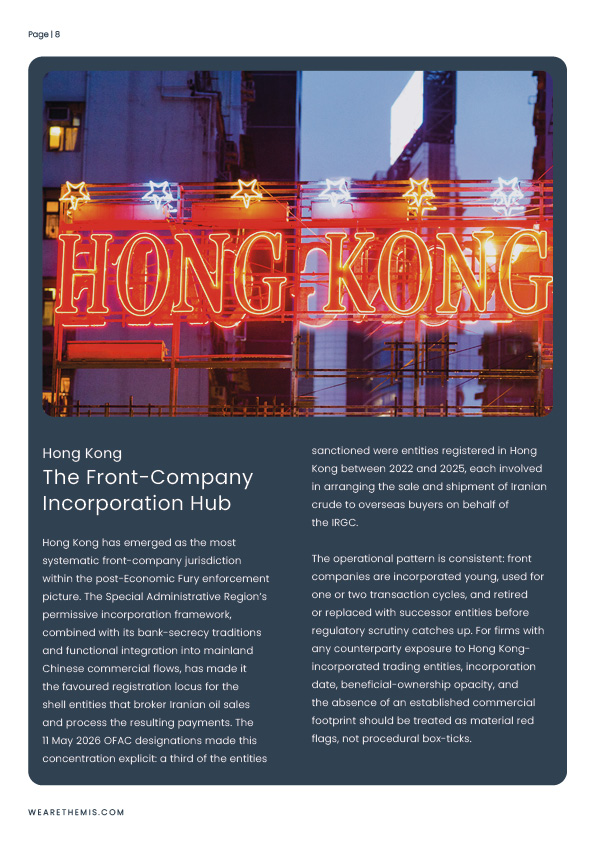
- Hong Kong as the front-company incorporation hub of choice - how a third of the May 2026 OFAC designations were Hong Kong-registered entities, the pattern of short-lived shells used for one or two transaction cycles before retirement, and what this means for firms with any counterparty exposure in the region
- A shadow fleet deep dive - covering AIS manipulation, ship-to-ship transfers at the Eastern Outer Port Limits near Singapore, cargo blending with Malaysian and Indonesian crude, and a documented operational cycle involving the Iranian-flagged tanker Herby and its interception by the USS Rafael Peralta
- An examination of the Axis of Evasion - how Iran, Russia, and China share overlapping procurement networks, with Chinese companies shipping drone components including engines linked to Shahed-136 attack drones deployed in Ukraine, and the ESG implications for boards and investors
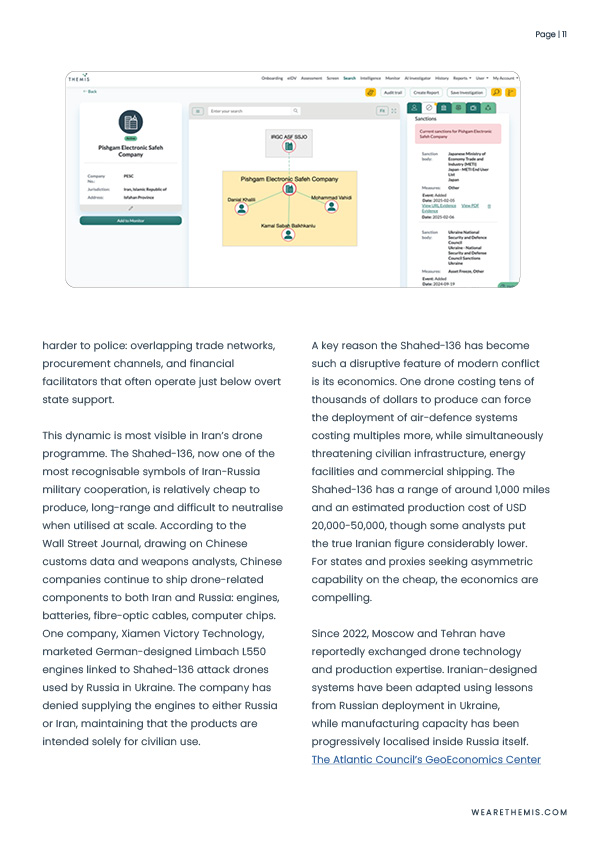
- Practical guidance on what surface-level screening misses - and how Themis maps Rahbar-linked shells, shadow fleet vessel relationships, CIPS-settled transactions, and dual-use procurement networks to give firms a clear view of their actual exposure