

Platform

Resources

For Virginia Woolf, financial independence and a ‘room of one’s own’ were the essential conditions of free expression. In the context of today’s UK real estate market, many white-collar criminals might readily agree, particularly where they do not need to occupy the room themselves.
Concerns regarding financial crime risks in the UK property sector show no signs of easing. Despite London’s housing market being valued at nearly a quarter of the entire UK residential market, with an average value of £2.64 trillion, the British capital has gained notoriety as a financial laundromat over the past decade. The scale of the issue has become particularly apparent after the release of the National Risk Assessment of Money Laundering and Terrorist Financing in July 2025.
The report estimates that as much as £10 billion may be laundered through the UK property market each year. The main vehicles for this are complex ownership structures: secretive shell companies, opaque trusts, real estate investment trusts and services provided by ‘professional enablers.’
It is the latter category that we would like to draw attention to in this blog. A professional enabler is defined by the UK’s National Economic Crime Centre (NECC) as “an individual or organisation that is providing professional services that enable criminality. Their behaviour is deliberate, reckless, improper, dishonest and/or negligent through a failure to meet their professional and regulatory obligations.”
Professional enablers span a wide range of organisations, from accountancy firms and estate agencies to family offices and auction houses. Their role has been closely scrutinised in recent years; Transparency International’s “At Your Service” report (2019) examined the extent to which UK companies - knowingly or not - helped criminals launder money. In March 2025, the organisation published another report, entitled “Opacity in Real Estate Ownership Index,” which revealed existing gaps in the property markets’ due diligence and anti-money laundering frameworks in 24 jurisdictions, highlighting an ongoing problem of opacity in the industry globally.
This article explores key trends on risks associated with professional enablers in UK real estate, before examining a real investigation our analysts conducted – one that revealed how a subject was using property purchases and financial services to enable money laundering on behalf of hidden clients.
Recent research suggests that the term ‘professional enabler,’ while widely used, may not fully reflect the reality of how people become implicated infinancial crime. Some argue that, although industries like real estate and luxury trading and professions such as accountants and legal professionals are the most vulnerable to exploitation by money launderers, the individuals within those industries and professions are more likely to have fallen into the role unknowingly, rather than being direct perpetrators themselves.
Transparency International, for instance, defines five categories of service providers’ involvement: Active compliance, Unwitting involvement, Wilfully blind, Corrupted, and Complicit, depending on the level of awareness among those caught up – deliberately or otherwise – in enabling illicit activity.
Experience conducting AML investigations at Themis shows that uncovering money laundering requires looking beyond surface-level transactions – understanding the context, the actors, and what is being concealed.
Themis investigated a UK-based financial consultant servicing wealthy individuals based across Bangladesh, Qatar and the UK.
The team identified that the individual’s financial services firm appeared in Bangladeshi news reports as an alleged facilitator of a money laundering scheme between South Asia and the Middle East on behalf of a Bangladeshi shipping company owner who was accused of laundering over $300 million from a wildlife-trafficking network in Dhaka.
During the investigation into the subject’s affairs and media presence, our analysts discovered that the financial advisor was described as having established three companies in Qatar, through which the proceeds of the trafficking network were redirected into various investments in those companies’ names. Our analysts identified a police investigation which mentioned the Qatari companies alongside the subject’s primary financial consulting firm and four associated individuals, recognised on company registers as directors.
A deeper dive into the cultural context, supplemented with discreet interviews with individuals who personally knew the subject, revealed that they were commonly known in Bangladesh and Qatar as a benami.
In much of South Asia, the term “benami” refers to a practice in which property or assets are held in the name of someone other than the true beneficial owner. The concept, as outlined in South Asian public sources, centres on concealment. The “benamidar” appears as the legal owner on paper, while an undisclosed party provides the funds and retains real control.
In anti-money laundering discourse, benami arrangements are understood in several variants, including the “Benami Trust,” where the trustee or named owner is merely a façade. While benami arrangements are not always illegal – they share structural similarities with offshore company arrangements used globally – professionals who offer this kind of service carry real risk of facilitating illicit fund flows, whether they are aware of it or not.
In light of these risks, Bangladesh prohibited benami transactions, introducing the law in the Land Reforms Ordinance (1984), which expressly bans the holding of immovable property in another person’s name for the real owner’s benefit. Section 5 of the Ordinance states that no person may purchase immovable property for their own benefit in the name of another, and any transfer made through a registered deed is legally presumed to reflect the genuine beneficial interest of the transferee.
Similarly, India introduced the Prohibition of Benami Property Transactions Act (1988, strengthened by the 2016 amendments), which outlaws any arrangement where a property is held by one person while the funds and beneficial interest belong to another. The law mandates confiscation of benami assets without compensation and criminal liability for those who initiate, facilitate or participate in such arrangements.
In the case of our subject, the picture was far from simple, requiring a jurisdictional analysis of their appointments in three countries: the UK, Qatar and Bangladesh. This research, together with human intelligence sources (HUMINT), allowed the analysts to establish that the subject was using their role as a benami in financial consulting and UK real estate sectors to assist their clients in money laundering.
Despite maintaining an extremely low public profile, the subject had been involved in the financial advisory industry in the UK for approximately 15 years, with UK Companies House reflecting more than 140 appointments under their name.
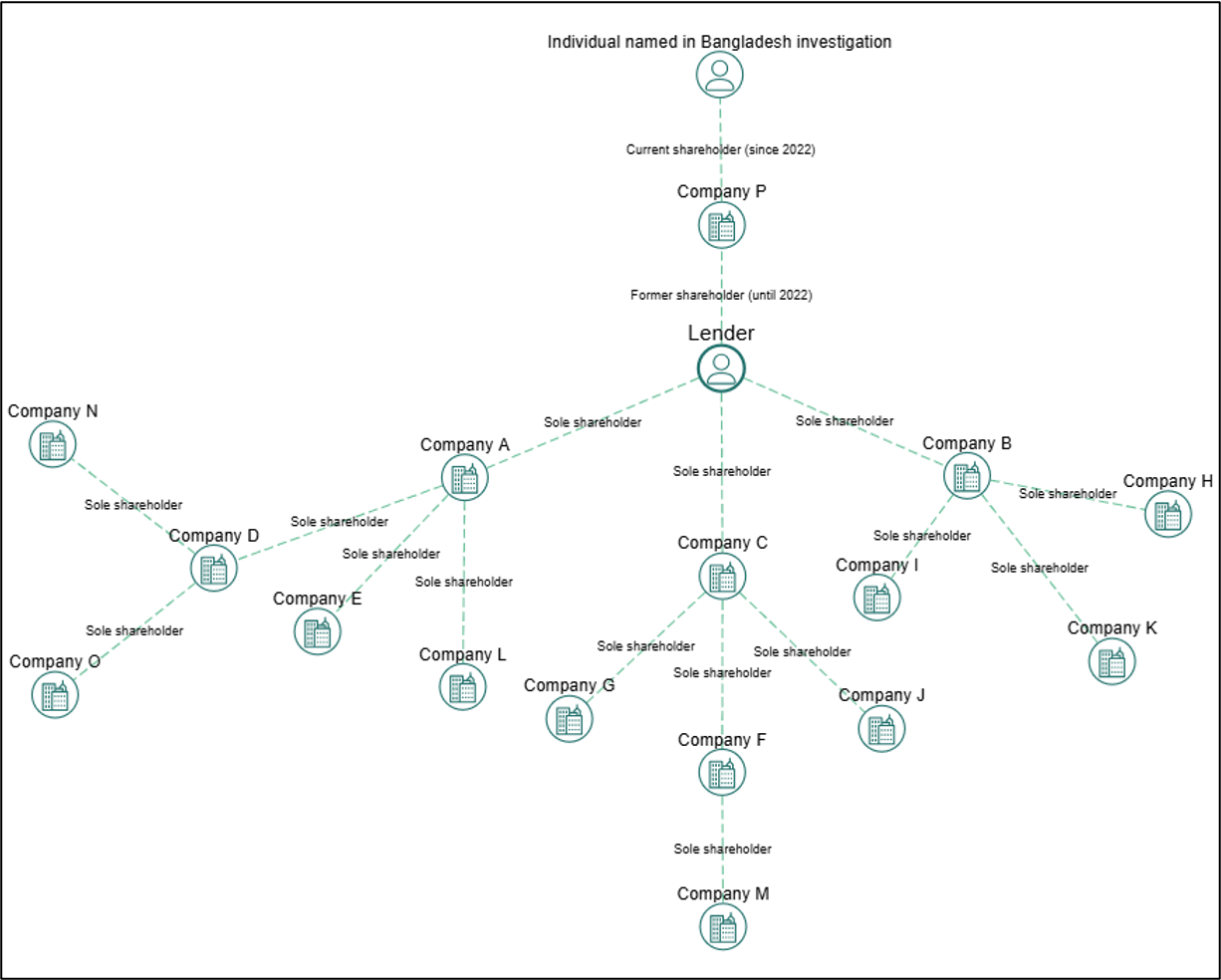
Further analysis showed that the subject remained a director in approximately 80 active companies, with half registered within the real estate industry, many of them dormant. The key finding was that fifteen of these companies were confirmed as currently owning properties on the UK Land Registry for a total value of over £65 million.
An analysis of available documentation revealed that the companies were directly interconnected through their registered mortgage charges – which ultimately led to a single lender with an extremely low profile. That lender, identified through Open-Source Intelligence (OSINT) research, was listed as the beneficial owner of a UK company, which is currently owned by the individual that was named among the facilitators of the $300 million money laundering scheme in Bangladesh.
Further open-source research showed that the subject’s UK-registered companies were associated with an individual accused of and arrested for laundering billions of dollars’ worth of a loan dedicated to the construction of a hospital in Sri Lanka, which was ultimately diverted to other entities – among them a company associated with the subject of Themis’ investigation.
As part of the investigation, suspicions raised through OSINT were confirmed by individuals that were personally acquainted with the subject. Human Source Intelligence (HUMINT) research revealed that the subject held a negative reputation across all three jurisdictions, including the UK, Qatar and Bangladesh.
Sources consistently indicated that the subject’s source of wealth was derived primarily from their financial advisory firms based in the UK – which allegedly serve to launder the funds from the illegal activities of their clients. Furthermore, the sources stated that the assets owned by the subject in the UK may not actually belong to them, as the subject is widely understood to be a benami for secretive illicit actors, assisting them in perpetrating money laundering and tax evasion.
This case demonstrates that the structures supporting global money laundering remain as complex and layered as ever. Based across multiple jurisdictions, they involve a myriad of actors who each perform a key role in enabling the crime.
That is why thorough due diligence before entering any transaction matters more than ever. As existing research on professional enablers demonstrates, actors within a money laundering scheme may not always be aware of the illicit activities taking place but can become entangled in it, with the real perpetrators hidden in the shadows behind layers of opacity. While the UK government is working towards tackling the issue by reforming the anti-money laundering and terrorist financing supervision, as outlined in a report from October 2025, the journey of realising the changes in practice is not going to be easy, so it is crucial for organisations to stay vigilant.
In the real estate sector especially, understanding the background and the source of wealth of the client or buyer is crucial to avoid dealing with a benami or another type of professional enabler who has no genuine interest in the property itself - and who may be looking to launder illicit funds for a hidden client.
To make sure you stay on top of these risks, commissioning Themis’ Level 3 Enhanced Due Diligence reports which combine our team’s deep financial crime expertise and thorough OSINT investigation skills with the direct human insight from individuals connected to your subject is an effective place to start.


UK private credit litigation is set to rise as the credit cycle turns, echoing US trends in mis-selling claims. Fund managers, GPs and wealth managers should align marketing, due diligence and documentation now to defend against investor claims over disclosures, valuation and fees.

This piece develops the argument from our recent panel on emerging risks in private credit, with former FCA COO Emily Shepperd and Dan Hemming, financial services disputes partner at RPC.

In one set of marketing materials, the UK lender Market Financial Solutions told backers it had issued £45.4 million of loans in 2011. Its filed accounts for that year recorded £196. The gap sat in the public record, there for anyone who looked.




Lorem ipsum dolor sit amet, consectetur adipiscing elit, sed do eiusmod tempor incididunt ut labore et dolore magna aliqua. Ut enim ad minim veniam, quis nostrud exercitation ullamco laboris nisi ut aliquip ex ea commodo consequat. Duis aute irure dolor in reprehenderit in voluptate velit esse cillum dolore eu fugiat nulla pariatur.
Block quote
Ordered list
Unordered list
Bold text
Emphasis
Superscript
Subscript