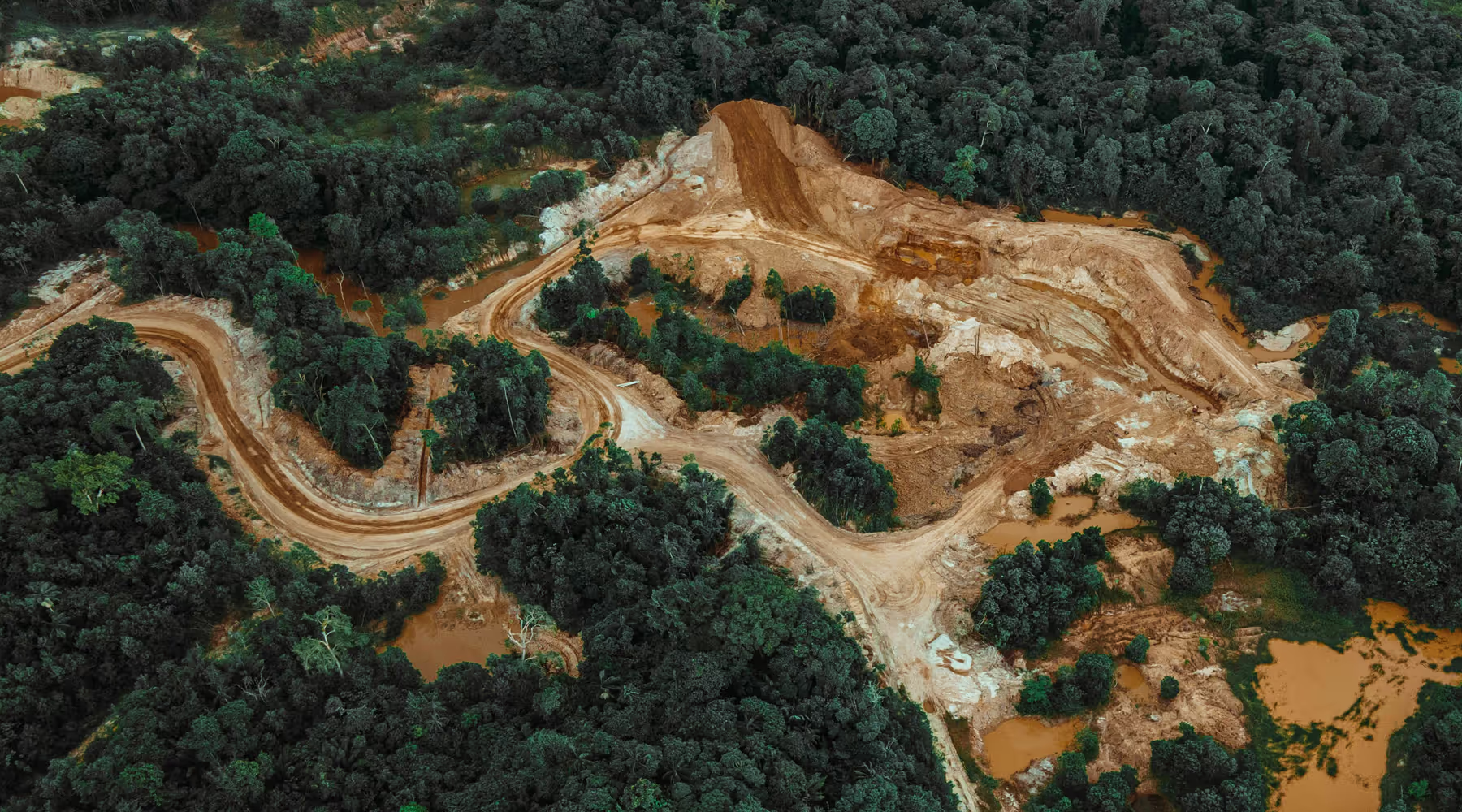

In the Central African Republic (CAR), Russia's involvement in the mining sector is a key strategy maintained to evade sanctions, allowing both economic and geopolitical advancement The Wagner Group, a paramilitary organisation with close ties to the Kremlin, plays a crucial role in this process. By securing profitable mining contracts, notably in the gold and diamond industry, Wagner circumvents Western financial sanctions imposed due to Russia's internationally condemned military actions in Ukraine. In the CAR, Wagner's operations go beyond traditional economic interests, with security concerns also being prominent. Companies such as Finans M and Lobaye Invest, reportedly controlled by Wagner's leader, exploit mineral resources in the Central African Republic (CAR) under the guise of economic activity, reinforcing Russia's geopolitical presence. These entities facilitate the trade of precious minerals outside the formal banking system, enabling Russia to bypass sanctions. This strategy allows Russia to leverage CAR's rich minerals to sustain its economy and finance military activities in Ukraine. It is also crucial to note that Russian mining activity in the CAR is causing environmental damage, including land degradation, deforestation, and water pollution, due to a lack of regulation. If Russia's involvement in CAR succeeds, similar unregulated mining projects could spread throughout the sub-Saharan region, increasing environmental harm.

A report by Afrik 21 has found that the export of Cameroonian timber to Vietnam involves significant environmental and fiscal abuses, including illegal logging and false invoicing. To safeguard its forest biodiversity, which covers 48% of the country, Cameroon enacted a law in 1999 that strictly bans the export of certain wood species in log form, including doussie, mukulungu, sapelli, padouk, and movingui. However, after a three-year investigation into the timber trade route between Cameroon and Vietnam, the Environmental Investigation Agency (EIA) and the Centre for Environment and Development (CED) have uncovered the extent of illegal activities in the sector, characterised by corruption, false invoicing, and unlawful logging. These illegal activities allow loggers to largely bypass existing regulations. The report reveals that at least 132,000 m_ of logs were exported from Cameroon to Vietnam in violation of forestry regulations from January 2016 to July 2020. This illegal trade has resulted in an estimated loss of $58 million in public revenue during this time period. The report also suggests that state agents may be complicit in the illegal timber trade.
A Global Witness investigation revealed how illicit practices in the Central African Republic (CAR) timber industry has helped finance conflict in the country. According to the investigation, logging companies have paid millions of euros to armed groups to ensure that they can continue operating in the country, with companies continuing to offer CAR timber for sale on international markets. One of the country's leading timber exporters, SEFCA, was accused of paying significant sums of money to armed groups in the country, including a �381,000 payment to the Seleka, an alliance of rebel militia groups accused of numerous human rights violations.
Cameroon faces significant challenges in relation to children's rights, particularly in artisanal mining areas. These areas employ many children, who are left exposed to several forms of exploitation, one of the most severe issues being sexual exploitation. According to a 2023 UNICEF report, around 20,000 children in these areas are survivors of sexual exploitation, with half of them being girls. These children are often exploited by mineral buyers, police officers, and other adults, forced into prostitution, sexual services, or marriages with adult men. This exploitation is primarily due to poverty, as well as a lack of education, and a weak state presence in these areas. The consequences for children who are sexually exploited are severe, including mental health issues, physical violence, school dropouts, and increased involvement in crime and prostitution. Despite efforts by the Cameroonian government and civil society organisations to combat this issue, measures employed are not sufficient. Organisations like the Réseau des Femmes Leaders pour le Developpement (RFLD) play a crucial role in combating child sexual exploitation by organising awareness sessions and providing support to child survivors, including legal, medical, and psychological assistance.
An industrial rubber project in Cameroon is now being condemned for causing the largest single rainforest destruction in Central Africa, according to Rainforest Foundation UK._ In a statement released in November 2018, the representatives from 21 surrounding villages denounced the effects of the Sud-Cameroun Hevea (Sudcam) project on the rights and livelihoods. Established in 2008, Sudcam was granted nearly 60,000 hectares of forest without conducting an environmental impact assessment or consulting the numerous communities affected. Such extensive land clearing has severely affected local and indigenous Baka communities. Approximately 30 communities rely on the area granted to Sudcam for hunting, fishing, farming, and collecting forest products. Large-scale rainforest destruction in the area therefore poses a significant threat to local livelihoods. In addition, in 2015, three indigenous Baka communities living in the forest were forcibly evicted to make way for the plantation. Around 120 people were forced to seek shelter in neighbouring Bantu villages, where they now live in poor conditions and face severe discrimination and human rights abuses. To date, none of these individuals have received any compensation for their lost livelihoods.
Cameroon's Congo River basin forest sector is exposed to illegal timber logging as demand for high-quality wood in Asia is growing. Due in part to ineffective forestry sector governance and management, the region is emerging as a focal area for local and international criminal actors. The Congo Basin's rainforests supply a wide range of wood species, including African teak, rosewood, bubinga, iroko, sapele, and moabi, to key high demand markets such as China and Vietnam. It is estimated that up to 50% of the annual wood harvested in Cameroon is from small-scale logging, most of which is illegal. At the borders, traffickers falsely declare tree species to pass illegally harvested timber off as legal, with this wood then trafficked into neighboring countries and exported on to consumer markets. According to the research organisation ENACT Africa, both private sector and state operators can be involved in this illegal trade, with the industry in Cameroon steeped in corruption. A key concern is bribe-taking among senior officials, civil servants, and companies in exchange for timber logging permits. Unfortunately, well-meaning government authorities also often lack the resources needed to effectively monitor the country's vast forests.



Cattle can both themselves be laundered (if they are grazed on land that has been illegally cleared and converted to pasture) and used as a means of laundering criminal proceeds from other exploits, like drugs trafficking. In Brazil, cattle have been laundered to obscure their links to land clearing, when they are moved from ranches that have contributed to land conversion through "clean" ranches that have not resulted in recent forest loss. In 2009, several Brazilian slaughterhouses signed the Terms of Adjustment of Conduct, an initiative of the Federal Prosecution Office and the Public Commitment on Cattle Ranching, and a voluntary protocol developed by Greenpeace, which precludes them from purchasing cattle reared on deforested land. However, a single cow might pass through up to 10 farms before it is slaughtered (from birth, through rearing and fattening). Any of these farms might be linked to illegal deforestation but many slaughterhouses assess links to deforestation only on the last farm a cow passes through - their direct supplier. As long as the last farm in the supply chain is from a "clean" ranch that is free from recent deforestation then slaughterhouses (and subsequent transporters and retailers, like supermarkets) are likely to mark them as deforestation-free, even if they have spent the majority of their life on and have passed through nine other ranches that have been converted from forested land. Indeed, data indicates that some ranchers own both "dirty" and "clean" ranches and launder cattle through their own properties. So long as one property is kept clean, they can continue to clear land for cattle grazing purposes on any number of other ranches. Other investigations by Global Witness have found that ranchers have fraudulently edited the boundaries of their ranch once they have cleared areas of land, so that this land conversion is no longer included within the property's scope and the ranch appears free from deforestation. This is alleged to be the case for the Fazenda Espora de Ouro II Ranch in Brazil's Pará state, which Global Witness also found appears to be registered in the name of an individual who could not legally be its owner (based on assessment of a database of land titles and beneficiaries). Cattle can also 'and concurrently' be used as a means of laundering the proceeds of illicit activity. Drug traffickers, especially in Colombia (where the traceability of beef produce is particularly poor), Honduras, and Guatemala, are known to launder revenue from drugs by buying or grabbing land which they convert into pasture for cattle, which they also purchase with narcotrafficking proceeds. When the cattle are sold, profits are hard to trace back to the drug network and their illicit proceeds are effectively laundered. This practice, known as "narco-ranching", is suspected of contributing up to 87% of deforestation in the Maya Biosphere Reserve, a large UNESCO heritage area of forest which covers over 2 million hectares of rainforest across northern Guatemala and borders other protected forests in Mexico and Belize. The Reserve is highly vulnerable to deforestation by crime groups due to its strategic location along a significant drug trafficking route up through Guatemala and Mexico leading to the US. Cattle ranching in such areas also frequently serves to hide airstrips and production facilities used by traffickers to produce and transport drugs or other illicit products. Airstrips now pepper the Maya Biosphere reserve, which are used by planes coming in from Colombia and Venezuela with cocaine to be smuggled across the border into Mexico.

A report commissioned by the government of Burkina Faso revealed that extremist political groups frequently attacked gold mines in order to access gold as a source of funding. Since 2016, armed extremist groups have accumulated 70 billion CFA francs ($126 million) following attacks on mining sites. These extremists, often linked to Islamic State and al-Qaeda, target gold mines in order to seize control and extort taxes. The central governments' limited control over mining regions leaves communities vulnerable, and struggling to defend themselves from these well-armed groups. Extremist groups not only target gold mines in the aims of conflict financing, but also to supply explosives for terrorist activities. Terrorist groups view the control of gold mines and transport routes as crucial for legitimacy and power over local populations. This control leads to violence as groups compete for profits and dominance. Lastly, the loss of governmental tax revenue from gold smuggling undermines funding for social programs and counter-terrorism efforts.
A report by the United Nations Office on Drugs and Crime details how the illicit gold trade in Burkina Faso has played a critical role in financing conflicts. Artisanal and small-scale gold mining (ASGM), a focal point for the country's economy, provides resources to non-state armed groups, and contributing to instability in the region. In Burkina Faso, ASGM produced approximately 49.5 tons of gold in 2018, valued at around $2.7 billion in 2022. The artisanal gold mining market is a significant source of income for many communities, but a big portion of this gold is smuggled out of the country, avoiding formal channels and taxation. The revenue derived from this illicit trade is often reinvested in weapons and vehicles, providing increased economic prosperity for armed groups, such as those affiliated with Jama'a Nusrat ul-Islam wa al-Muslimin (JNIM), during conflicts. The influx of weapons into the region, especially after the 2011 Libyan revolution, has made arms readily available to different groups, contributing to the weaponisation of existing trafficking routes. In addition, the smuggling networks also play a role in supplying armed groups with recruits. Migrant smugglers, for instance, liaise with armed groups and pay taxes for safe passage through territories controlled by these groups.
According to a press release issued by the Brazilian government, an Operation led by its Federal Police dismantled an international criminal organisation involved in the illegal extraction, trade, and export of precious stones, particularly rough diamonds and gold. On April 26, 2023, Brazil's Federal Police launched Operation Itamarã, which encompassed a total of 42 search and seizure warrants and eight preventive arrest warrants across several Brazilian states and involved international cooperation with the United States, Belgium, England, and the United Arab Emirates. Investigations began in 2020, as the organisation's activities were first revealed through the arrest of a suspect at Guarulhos International Airport. The suspect was found carrying rough diamonds without proper documentation. Subsequent seizures included gold bars at Confins/MG Airport and rough diamonds intercepted with the help of U.S. Homeland Security Investigations. The Operation eventually uncovered that the criminal organisation had extensive operations in over a dozen countries, involving complex financial schemes and the use of shell companies to issue false invoices. They also co-opted legitimate companies to facilitate the illegal export of precious stones.
According to Mongabay, a boom in illegal cattle ranching activities in the Arariboia Indigenous Territory in Brazil has caused illegal deforestation and violations of Indigenous rights. An increase in commercial cattle ranching has encroached on large plots of the Arariboia Indigenous Territory. Several bans against such establishments are in place, but cattle ranchers are able to find loopholes since Brazilian laws do not require buffer zones around Indigenous territories, unlike conservation units. Commercial cattle ranching in the area has caused illegal deforestation, as well as other illegal activities such as the construction of an unlicensed airstip in mid-2023. In addition, the local Indigenous community, the Guajajara, has faced harassment and violence from the illicit loggers. In 2023, four killings and three attempts on their lives were recorded. Killings correlate with areas of illegal activities and police operations against illegal logging. In addition, water contamination and reduced fish stocks due to cattle farming chemicals affect the Guajajaras health and food sources.
Brazilian federal authorities launched an investigation into a money laundering network suspected of moving millions of dollars' worth of illicit gold in 2023. Through a network of shell companies, individuals are alleged to have moved money linked to gold illegally sourced from Brazil's northern neighbor Guyana. In one instance, a shell company purportedly to be trading hospital supplies was alleged to have laundered over $12.3 million in gold. Shell companies play an important role in Brazil's illicit gold industry, with these companies providing a way for criminals to issue invoices without a physical address to hide the illegal origin of exported gold. Authorities have estimated that over 30 tonnes of gold is illegally extracted each year from the Brazilian Amazon, with this illicit practice exploiting low-earning miners in areas of poor human and economic development, causing considerable deforestation and socio-economic harm.
In Pará, Brazil's largest palm oil-producing region, violence, land grabbing, and forced evictions of Indigenous, Quilombola, riverine, and campesino communities have been escalating since early 2022. Local leaders allege that government officials have encouraged palm oil producers to suppress any opposition violently. Two major palm oil companies are at the centre of these conflicts. Brasil Biofuels (BBF) is accused of using violence and intimidation against Indigenous and traditional communities. BBF allegedly employs armed security to intimidate and forcibly remove community members from their lands, leading to violent conflicts with the Tembé, Turiuara, and Pitauã Indigenous peoples. Agropalma is linked to fraudulent land grabs, acquiring land with illegal titles, and displacing communities. Despite their denials, both companies are reportedly responsible for severe human rights abuses. Major international brands such Mondelez, Nestlé, PepsiCo, and Unilever continue to source palm oil from BBF and Agropalma, indirectly supporting these human rights violations.
Belo Sun Mining Ltd, a Canadian company based in Toronto, has been developing the Volta Grande gold project in Pará State, Brazil since 2012. The project, including a planned open-pit gold mine, is the ancestral home of several Indigenous Peoples and riverine (Ribeirinho) communities. The project has faced numerous legal challenges and complaints. The main issues include inadequate impact studies on Indigenous Peoples, questionable licensing processes, insufficient consultation with Ribeirinho communities, and potential violations of land rights. Despite these challenges, the project was designated a priority under Brazil's 2021 Pro-Strategic Minerals Policy. Human rights defenders, including Indigenous Peoples, have faced ongoing threats and intimidation related to their opposition to the project. Belo Sun's security firm, Invictus, reportedly intimidated local communities with armed patrols and surveillance. For instance, in October 2023, Belo Sun filed a criminal complaint against 40 individuals accusing them of criminal activities related to land protests.
A legal complaint against the US-based agricultural giant Cargill has been filed following its failure to adequately deal with its participation in soy-driven deforestation and human rights violations in Brazil. Cargill allegedly failed to implement adequate monitoring methods to oversee the vast quantities of soy it trades, handles at its ports, and ships to global markets. This deficiency prevented the company from identifying and eliminating links to deforestation and human rights abuses, thereby breaching its legal due diligence responsibilities. Due diligence deficiencies include a lack of proper environmental due diligence on soy bought from third-party traders, no due diligence on soy owned by other companies passing through its ports and failure to address indirect land use change.The complaint also highlights human rights failures, including forced displacement and violence against land defenders linked to Cargill's operations, and the destruction of traditional ways of living due to deforestation.
A 2023 investigation uncovered that seven agribusiness giants, including Bunge, Cargill and COFCO, bought grains, notably soybeans, from Brazilian farmers fined for illegal cultivation on Indigenous lands in Mato Grosso. However, the grain sales invoices failed to identify the farms as being inside the Indigenous lands, falsely stating other lands of origin to allow the business to take place. In addition, the investigation found that five identified producers fined by IBAMA in 2018 for cultivating crops within Indigenous lands continued to make sales to large international grain traders during the periods of interdiction from 2018 to 2019. A practice of 'grain laundering' was used to facilitate this illegal trade. This practice involves mixing illegally produced grains from conservation units, seized lands, or interdicted areas with legally planted and harvested soybean and corn, thereby concealing the irregular origin of a portion of the crop. The close proximity of these farms, listed on invoices as the origin of the produce, to Indigenous lands facilitated this 'grain laundering'. Grain laundering was openly acknowledged by farmers in the Paresi Indigenous region in March 2019.
A criminal complaint has been fined against several French banks, accusing them of money laundering and financing meat companies driving deforestation in Brazil. From 2013 to 2021, the four French banks involved, BNP Paribas, Credit Agricole, BPCE, and AXA, invested nearly $70 million in bonds issued by leading Brazilian meat companies, generating about $11.7 million in profits. An analysis of JBS and Marfrig slaughterhouses, financed by such investments, in Pará and Mato Grosso found that over 50% and 40% of suppliers, respectively, showed evidence of deforestation and intrusion into Indigenous lands. The founder of the NGO Harvest, that contributed to initiating the complaint, emphasised that banks have an obligation to prevent money laundering and must exclude actors profiting from illegal deforestation. In response to the complaint, Credit Agricole and BPCE did not comment, while BNP Paribas and AXA provided statements emphasising their commitment to ESG standards.
According to the Organized Crime and Corruption Reporting Project (OCCRP), seven individuals were detained in Pará, Brazil after suspicions of illegal Amazon timber trade. Among those detained is a former employee of the Pará Environmental Secretariat (SEMAS). Investigation began in 2019, with the operation "Dark Wood" involving a total of nine search and seizure warrants and the freezing of bank accounts. The two-year investigation sought to dismantle the criminal scheme that enabled the illegal extraction of sale and timber. The scheme involved laundering wood from illegal deforestation, yielding significant profits. It disguised the origins of illicit wood, which was then exported to the United States. Yellow Ipê wood, highly valued in the U.S., was a primary target. During their investigation, the Brazilian Civil Police eventually uncovered forged documents used to simulate forest product auctions. These allowed companies to introduce fraudulent permits into the Forest Products Commercialization and Transportation System (Sisflora). Operation "Dark Wood" resulted in the detention of guilty sawmill owners and former SEMAS employees across various locations in Pará and the Federal District. The identities of the suspects and companies remain undisclosed.
A report by InSight Crime demonstrates the growing ties between drug trafficking and illegal timber logging in Brazil's Amazon. The report details how timber shipments from the Amazon are now being used to conceal drugs, primarily cocaine, for export to foreign countries. From 2017 to 2021, authorities seized nearly nine tons of cocaine hidden within timber shipments destined for European countries. In addition to drugs being hidden in timber shipments, the ties between illegal timber logging and drug trafficking is also the consequence of organised crime groups in Brazil diversifying their activity. Indeed, organised crime groups in Brazil have also become involved in illegal mining, land grabbing, logging, gold trading, and invading indigenous lands. Criminal gangs have been known to buy land illegally in the rainforest to profit from logging and to establish marijuana plantations, particularly in Pará's "Marijuana Polygon.". From 2015 to 2020, more than two million marijuana plants were seized across the Amazon region, with 55% of these seizures occurring in Pará.
An investigatory report by Greenpeace led to allegations that South Korean machinery manufacturer HD Hyundai Construction Equipment (HD HCE) contributed to deforestation in the Amazon by providing excavators to illegal gold miners operating within Indigenous territories, in areas of Brazil which were degraded 202% more between 2019 and 2021 compared to the preceding decade._ In the Indigenous lands of Yanomami, Munduruku, and Kayapó, 75 Hyundai excavators were identified during aerial surveys conducted between 2021 and 2023. Illicit mining activities have led to a humanitarian crisis in these areas; for example, contaminated rivers have posed health risks to Yanomami adults and children.
A study found that tax havens offer a major conduit through which investors can fund agribusiness in tropical areas; 68% of all investigated foreign capital flowing into nine of the top companies in the soy and beef sectors in the Brazilian Amazon was transferred through tax havens between 2000 and 2011. A large proportion of this was through the Cayman Islands. The report noted that the secrecy and transparency offered by such havens appear to be important to those investing large sums in agribusiness companies responsible for significant land conversion in the Amazon, likely because it protects them and allows them to more thoroughly conceal their involvement.
According to Mongabay, it was uncovered in February 2023 that three landowners had orchestrated the largest single instance of deforestation in the Brazilian Amazon's history, clearing 6,469 hectares of forest in Pará state. This large-scale land grab, conducted between February and May 2020, cost at least $2.5 million and is expected to yield nearly $20 million in profits from selling the land for soy farming or cattle ranching. This took place along the BR-163 highway, between the districts of Castelo dos Sonhos and Vila Isol, regions known for their economic activities, including gold mining, timber, cattle, and soybean farming. The land, initially public and belonging to the Brazilian federal government, was illegally appropriated and cleared without environmental authorisation. This deforestation, larger than the area of Manhattan, represents a significant loss of biodiversity and a contribution to climate change, as well as a breach of Brazilian environmental laws. The three key figures behind this land grab are Jeferson de Andrade Rodrigues, Delmir José Alba, and his brother Augustinho Alba. They all have a history of environmental fines and infractions.
The Brazilian Federal Regional Court of the 1st Region convicted three companies for the illegal logging and subsequent transportation and trade of wood from the Rondônia region of the Legal Amazon. The companies involved are Celia Ceolin EPP, BV Indústria e Comércio de Madeiras Ltda ME, and Madeireira Mil Madeiras Ltda EPP. Each company was fined US$100,000 and ordered to plant 10 hectares of the protected Brazilian tree that had been illegally exploited. The conviction followed Operation Guardians of the Mountains in 2008, where authorities were able to seize 600 cubic metres of timber illegally logged in the Amazon, as well as 17 trucks. The wood had been sawn without authorisation, whereas Mil Madeiras had falsely advertised on their website that they operated in an environmentally conscious manner, claiming certification from Brazilian environmental authorities. However, the exploitation of Brazilian nut wood, found during the Operation, has been prohibited since the early 1990s. The court also found that, in addition to the illegal cutting of protected trees in the Amazon, the companies laundered the timber by mixing the illegally logged wood with legal logs, and their records never mention the Brazil nut.

The Global Witness report titled "Empty Promises: Cargill, Soy, Banks and the Destruction of Bolivia's Chiquitano Forest" reveals that US food giant Cargill has directly purchased soy from farms in Bolivia where more than 20,000 hectares of forest have been razed since 2017. The report suggests that Cargill is systematically failing to collect key data about the origins of its soy supplies in Bolivia, casting serious doubt on its commitments to achieving fully traceable and "deforestation-free" supply chains. The report also reveals that Cargill's global operations have been bankrolled by financial institutions including Barclays, BNP Paribas, HSBC and Santander, despite these firms' pledges to eliminate or reduce deforestation from their portfolios. The report concludes with a series of urgent recommendations to the EU and UK, US and Bolivian governments, to the world's biggest and most influential banks, and to Cargill itself.
Corruption is a significant issue in the Bolivian timber industry, with false or fraudulent documents being issued by government officials. Companies launder illegal timber into supply chains by fraudulently obtaining paperwork, falsifying the Forestry Origin Certificate (CFO), or selling timber without a CFO. Most of this illegal timber comes from protected areas, indigenous territories, or natural forests. Illegal timber is laundered out of Bolivia by loggers making fraudulent declarations of greater numbers of trees than exist, artificially inflating the number of trees in authorised forest management areas or logging plans. This allows them to supplement their timber consignment with illegally extracted timber from other areas. Reno Noel Silvia Cespedes, a former Forest and Land Authority (ABT) official, reportedly signed 2,096 documents authorising the clearing of protected areas between 2015 and 2018. A 2018 report by the ABT found that the agency authorised the cutting of at least two protected species at far higher rates than is permitted by law.


The Environmental Crimes Financial Toolkit is developed by WWF and Themis, with support from the Climate Solutions Partnership (CSP). The CSP is a philanthropic collaboration between HSBC, WRI and WWF, with a global network of local partners, aiming at scaling up innovative nature-based solutions, and supporting the transition of the energy sector to renewables in Asia, by combining our resources, knowledge, and insight.