

Platform

Resources

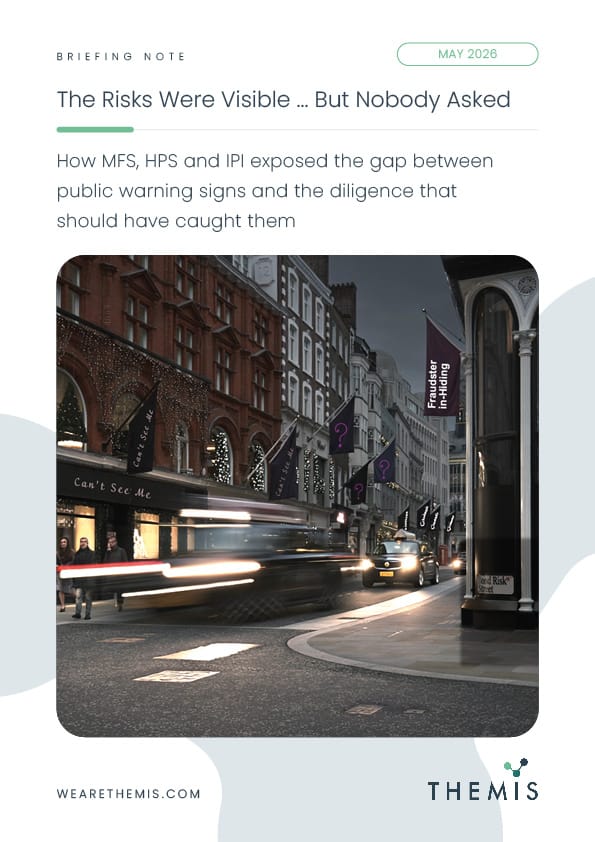
In one set of marketing materials, the UK lender Market Financial Solutions told backers it had issued £45.4 million of loans in 2011. Its filed accounts for that year recorded £196. The gap sat in the public record, there for anyone who looked.
MFS collapsed in February amid allegations of double-pledged collateral and circular refinancing. A worldwide asset freeze now covers its founder and the FCA has opened an investigation. Barclays has taken a £228 million hit and HSBC a charge of around $400 million through indirect exposure. Yet experienced institutions kept lending while the evidence sat on the public file, which should trouble the sector more than the collapse itself.
The strength of private credit, the dense web of funds, banks, sponsors and intermediaries that moves capital quickly, is also its main weakness. One borrower’s misrepresentation can spread into losses across the market, because no single lender sees the whole picture and too many assume someone more sophisticated has already done the checking.
A respected name in a deal becomes a substitute for the work itself. Call it herd diligence. If a large manager is already lending, the thinking goes, the checks must have been done. Backing by established firms lent MFS a credibility that discouraged harder questions, and each lender’s involvement reassured the next.
This is not only a problem for less experienced firms. Last year HPS Investment Partners, among the most sophisticated direct lenders, then being acquired by BlackRock, lent more than $400 million against fabricated invoices and worthless collateral. The borrower’s record already held lawsuits, regulatory actions and bankruptcies. The information was there. Nobody connected or challenged it in time.
Two structural features make this likely, not unlucky. The first is fragmented visibility: a single borrower now draws on private credit funds, bank facilities, NAV lines and warehouse structures, so no lender sees its total leverage or whether the same collateral sits behind another loan. The second is timing. Diligence is too often a one-off exercise at origination. Concerns about MFS reportedly grew through 2025 as questions went unanswered, but the checks that mattered had been done at the start, when the story still held together.
The sector’s diligence model was built for a bilateral, point-in-time world. The market it now serves is networked and continuous, and regulators are pressing on the gap. The Bank of England’s system-wide exploratory scenario treats private credit as a financial stability question, and a House of Lords report, Private Markets: Unknown Unknowns, warned in January that supervisors cannot see into much of it. For the lenders themselves the pressure is closer to home. The FCA’s investigation into MFS concerns its compliance with the Money Laundering Regulations, and for authorised managers those systems-and-controls duties now sit with named senior individuals who are personally accountable.
Fraud has not become undetectable. Catching it now depends on looking across the network, not only at the counterparty in front of you, and on doing it continuously instead of once. It means mapping ownership, relationships and counterparties across the financing chain and watching them as conditions change. Some of that is capability; the rest is cultural and collective.
The warning signs in private credit’s recent failures were rarely invisible. The job now is to build a market structured to see them.
This is the problem Themis works on. We help lenders and investors map the network around a borrower and screen the ownership, related parties and counterparties for sanctions, adverse media and other integrity risks, then keep monitoring as conditions change. The result is an auditable record of the checks that were done, the thing an investment committee, an LP, an insurer or a regulator wants to see when asking whether the diligence was adequate. Read more about our work with private credit firms.

Based in London, Jake leads strategy, growth, and senior client relationships across the UK and Europe. He works with clients and partners to support strategic priorities, deepen senior relationships, and drive Themis’s expansion across European markets.He joined Themis from J Goodwin and Co, a boutique investment bank where he was a Partner advising later-stage technology companies on capital raising and M&A. Before that, Jake spent 15 years in Asia, including as a founding partner of Cassia Investments, a consumer private equity fund investing across China and Southeast Asia. He has also founded several technology companies.
To discuss Private Credit further, or get a recording of our recent webinar, Emerging Risks in Private Credit: Cockroaches in Plain Sight? Please get in touch.

UK private credit litigation is set to rise as the credit cycle turns, echoing US trends in mis-selling claims. Fund managers, GPs and wealth managers should align marketing, due diligence and documentation now to defend against investor claims over disclosures, valuation and fees.

This piece develops the argument from our recent panel on emerging risks in private credit, with former FCA COO Emily Shepperd and Dan Hemming, financial services disputes partner at RPC.

With recent geopolitical events, much of the world’s attention has been on Iran and the risks posed to businesses by an escalating conflict: risks that span fraud, money laundering and sanctions circumvention.




Lorem ipsum dolor sit amet, consectetur adipiscing elit, sed do eiusmod tempor incididunt ut labore et dolore magna aliqua. Ut enim ad minim veniam, quis nostrud exercitation ullamco laboris nisi ut aliquip ex ea commodo consequat. Duis aute irure dolor in reprehenderit in voluptate velit esse cillum dolore eu fugiat nulla pariatur.
Block quote
Ordered list
Unordered list
Bold text
Emphasis
Superscript
Subscript