

Platform

Resources

This piece develops the argument from our recent panel on emerging risks in private credit, with former FCA COO Emily Shepperd and Dan Hemming, financial services disputes partner at RPC.
Credit reaches a single borrower today through direct lending funds, bank facilities and warehouse structures at the same time, with further leverage layered above it through NAV and subscription lines. Each lender diligences its own exposure. None sees the borrower’s total leverage, and none can see whether the collateral supporting its loan is quietly supporting somebody else’s as well. The market became a network, and the risk moved into the connections.
Diligence did not move with it. The standard model was built for a bilateral, point-in-time world: do the work at origination, get comfortable, sign, move on. That was a reasonable design when a borrower had a lender and the relationship was legible. Applied to today’s market it has a structural blind spot, and the recent run of credit failures shows what sits inside it. We looked at the most instructive of those failures, the collapse of Market Financial Solutions, in an earlier piece.
Good diligence in this market has three properties it has historically lacked: it works at the level of the network, it runs continuously, and its depth follows the risk.
The unit of analysis is the first change. The entity in front of you can pass every check while the risk sits one step away, in the ownership chain, in a connected party, or in a counterparty elsewhere in the financing structure. In the failures of the last two years the decisive information rarely sat inside any single credit file. It sat between lenders, in ownership structures, public filings and litigation records that nobody joined up. Diligence that stops at the borrower’s front door is answering a question the market has stopped asking.
The second change follows from a fact every lender knows and few diligence processes reflect. A lender’s powers are the rights in the loan agreement, and almost nothing else. An equity investor who finds a problem after the deal can change the management and fix it. A lender cannot. For the life of the loan, you are relying substantially on the borrower telling you the truth in a quarterly certificate.
Those contractual rights cover more than the financial covenants. Facility agreements typically carry representations and undertakings on sanctions, financial crime and change of control. They are live for the full term and actionable on breach. Many are drafted as repeating representations, deemed re-made at every interest period, on nothing more than the borrower’s own certification. The financial covenants get recomputed every quarter because somebody owns that process. In most books, the integrity undertakings are checked once, at signing, and not looked at again for the years the loan is outstanding, while the ownership, the counterparties and the conduct behind them all move. A protection nobody watches is not a protection.

The third change is what makes the first two affordable. The exposures that warrant it get more scrutiny, more frequent refreshing and more human judgement. The rest get proportionately less. Continuous monitoring across a whole book only works economically when the intensity of the work is driven by the risk profile of each borrower and structure rather than applied uniformly. Run that way, it concentrates expert attention exactly where a uniform process spreads it thin.
This is what Themis enables. It enables a lender to map who actually owns and controls a borrower, and the network around it, before committing. It enables continuous monitoring of that network across the life of the loan: sanctions, adverse media, ownership and control changes, the events that put the integrity undertakings in play. And it enables depth to follow risk: screening runs continuously across the whole book, and where a signal warrants it, the case escalates to analyst-led enhanced due diligence. The undertakings already sitting in the agreement become an early-warning system instead of boilerplate, and the borrower’s compliance posture becomes a live input to credit risk instead of a closed file.
There is a second pay-off. The same monitoring produces a current, auditable record of who the borrower is, who it is connected to, what was checked, when, and who signed it off. That record answers the question investment committees, LPs, insurers and regulators are now asking in the same words: was the diligence adequate, and can you prove it. Not just adequate. Provably adequate.

Based in London, Jake leads strategy, growth, and senior client relationships across the UK and Europe. He works with clients and partners to support strategic priorities, deepen senior relationships, and drive Themis’s expansion across European markets.He joined Themis from J Goodwin and Co, a boutique investment bank where he was a Partner advising later-stage technology companies on capital raising and M&A. Before that, Jake spent 15 years in Asia, including as a founding partner of Cassia Investments, a consumer private equity fund investing across China and Southeast Asia. He has also founded several technology companies.
To discuss Private Credit further, or get a recording of our recent webinar, Emerging Risks in Private Credit: Cockroaches in Plain Sight? Please get in touch.
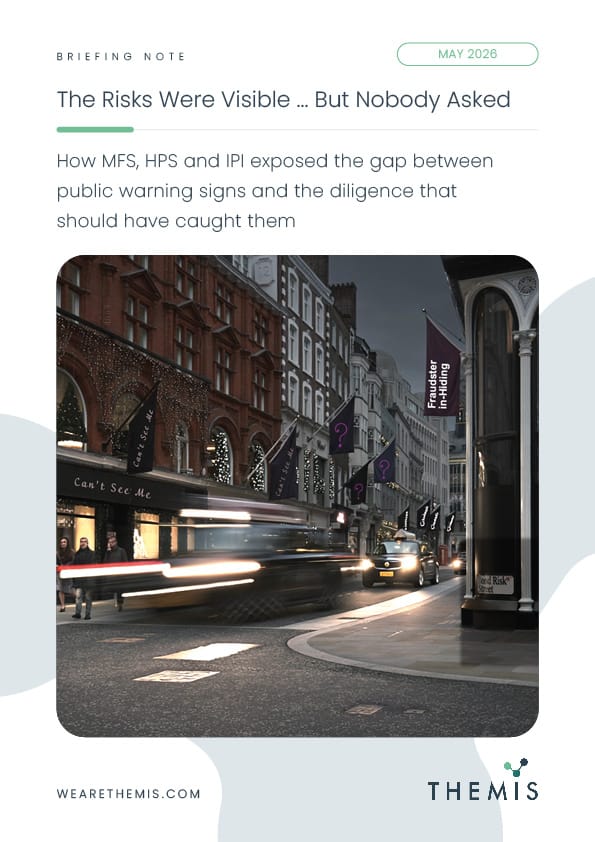

UK private credit litigation is set to rise as the credit cycle turns, echoing US trends in mis-selling claims. Fund managers, GPs and wealth managers should align marketing, due diligence and documentation now to defend against investor claims over disclosures, valuation and fees.

In one set of marketing materials, the UK lender Market Financial Solutions told backers it had issued £45.4 million of loans in 2011. Its filed accounts for that year recorded £196. The gap sat in the public record, there for anyone who looked.

With recent geopolitical events, much of the world’s attention has been on Iran and the risks posed to businesses by an escalating conflict: risks that span fraud, money laundering and sanctions circumvention.




Lorem ipsum dolor sit amet, consectetur adipiscing elit, sed do eiusmod tempor incididunt ut labore et dolore magna aliqua. Ut enim ad minim veniam, quis nostrud exercitation ullamco laboris nisi ut aliquip ex ea commodo consequat. Duis aute irure dolor in reprehenderit in voluptate velit esse cillum dolore eu fugiat nulla pariatur.
Block quote
Ordered list
Unordered list
Bold text
Emphasis
Superscript
Subscript